Contact Us
HARDWARE · AUTONOMOUS DRIVING DOMAIN CONTROLLER

L4 Autonomous Driving Controller

Bringing autonomous-driving compute into vehicle applications

Designed for autonomous logistics, mining transport and campus shuttle applications, the controller connects sensors, autonomous-driving compute and chassis control. With the AutoCore.OS software foundation and ADrive stack, it supports flexible integration from a controller component to a complete vehicle solution.

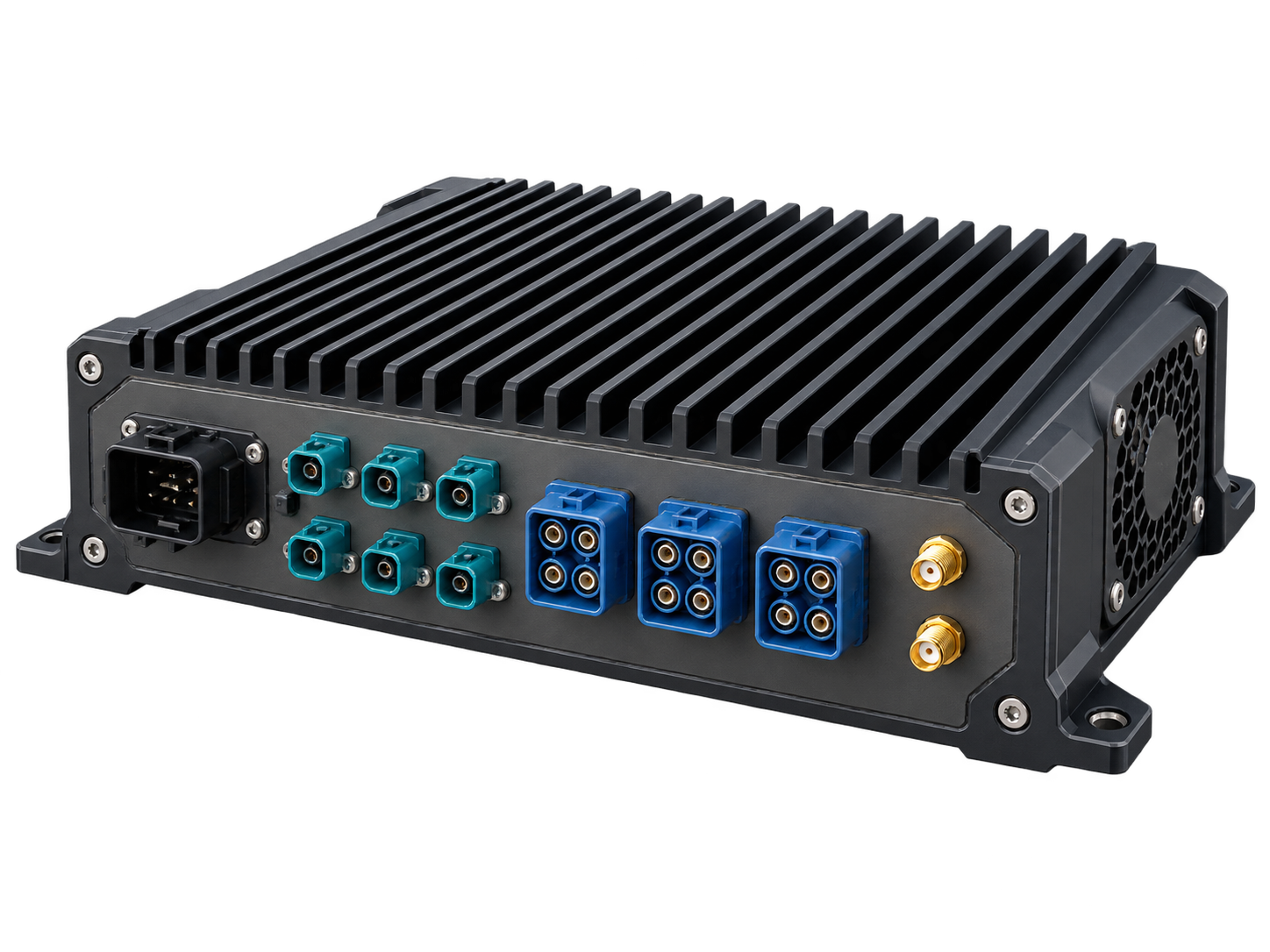
Concept rendering of the L4 Autonomous Driving Controller with air cooling, T1 automotive Ethernet ports, three four-in-one GMSL connectors and two antenna connectors
L4 Autonomous Driving Controller · Concept rendering
Dual-SoC architecture
Multi-sensor connectivity
Integrated hardware and software
01

Complete Connectivity from Sensors to Actuators

Co-designed compute platform and software

Using a dual-SoC architecture, perception, mapping and localization, planning, and control are deployed in separate domains and coordinated through inter-board links. Sensor data can be shared at high speed between SoCs, while fallback control, resource isolation and a safety MCU establish multiple layers of safety redundancy and a clear compute and control boundary for vehicle integration.

The diagram shows a typical logical architecture. Compute allocation, interfaces and fault-handling strategies are configured for each vehicle model and project.

02

Core Capabilities Built for Vehicle Deployment

Connectivity, operation, integration and maintenance

01

Unified Multi-Sensor Connectivity

Cameras, LiDAR and integrated navigation devices connect through drivers, time synchronization and calibration management, providing a consistent data entry point for perception and localization. Sensor types and quantities are configured per scenario.

02

Dual-SoC Coordinated Computing

Compute resources are allocated across perception, mapping, localization, planning and control workloads and coordinated through inter-board communication, with application resource isolation and redundancy.

03

Independent Software Deployment

AutoCore.OS organizes applications and communication while ADrive modules are packaged, deployed and upgraded independently, making algorithm assets reusable across compute platforms.

04

Drive-by-Wire Chassis Adaptation

Protocol adaptation and vehicle integration cover steering, braking, drive, gear and parking interfaces, forming a control loop with chassis feedback. Supported interfaces are confirmed per vehicle model.

05

Operations Management and Issue Tracing

Lifecycle management, health management, diagnostics, logging and data replay trace cross-module issues and support vehicle debugging, version maintenance and fault analysis.

06

Vehicle-Cloud Coordination and Validation

Connect to cloud monitoring, task dispatch, remote assistance and version management, then organize regression validation with simulation, HIL and vehicle testing to support continuous iteration.

03

Configure Compute and Interfaces for Each Application

Clear boundaries for vehicle-model selection

Configuration Area Capabilities and Selection Scope
Compute Architecture Dual-SoC configurations are available; the specific chips, compute performance, memory and storage are confirmed by delivery model.
Sensor Input Supports cameras, LiDAR and GNSS/INS devices; interface types, channel counts and compatibility lists are confirmed by model.
In-Vehicle Communication Ethernet, CAN / CAN FD and other connectivity options adapt the controller to sensors, in-vehicle devices and the chassis.
Software Platform AutoCore.OS and the ADrive software stack cover perception, localization, planning, control and system management.
Vehicle-Cloud Connectivity An in-vehicle communication device connects to the cloud-control platform for status reporting, task interaction and operations collaboration.
Vehicle Adaptation Power, power consumption, thermal design, dimensions, mounting, environmental adaptation and safety requirements are confirmed per vehicle model.

The controller is one part of an autonomous-driving system. Actual operating capability must be validated at the vehicle level with the sensors, chassis, software configuration and operational design domain.

04

From Component Delivery to Full Vehicle Solutions

Matched to different development and integration models

01

Controller and Foundation Software

Deliver the agreed controller hardware, drivers and foundation software interfaces, enabling customers to integrate their own algorithms and upper-layer applications.

02

Autonomous Driving Compute Kit

Combine the controller with ADrive software modules and sensor adaptation and complete joint debugging around the target scenario.

03

Full Vehicle Solution Integration

From sensor selection and chassis adaptation to vehicle-cloud coordination and validation, integration and delivery proceed according to the project scope.

05

Autonomous Driving Applications Across Scenarios

Reuse platform capabilities, adapt to each vehicle

01

Autonomous Logistics

For last-mile delivery, campus logistics and cargo transfer, sensor and compute resources are configured around payload, routes and operating tempo.

02

Mining Transport

For heavy-duty haulage, integration covers vehicle dynamics, operating workflows and cloud dispatch.

03

Campus Shuttle

For defined routes in campuses, scenic areas and similar environments, system adaptation and validation are organized around stops, road boundaries and operating rules.