Contact Us
HARDWARE · DETERMINISTIC NETWORKING

TSN Fusion — Deterministic Networking in Four Forms

Best-effort Ethernet forwards packets and hopes for the best. TSN makes Ethernet keep its promises: schedule-based forwarding, a network-wide time base and link redundancy. TSN Fusion packs switching, monitoring, endpoint and gateway capabilities into one hardware platform—switch firmware images to switch roles (TSN Switch / TSN Tap / TSN Endpoint / TSN Gateway) and deliver end-to-end deterministic connectivity for critical network infrastructure.

~5us
Gigabit forwarding latency · Fully hardware-based
<100ns
Hardware time-sync accuracy (IEEE 802.1AS · PPS verifiable)
0ms
802.1CB redundant failover
<1us
Qbv gate scheduling precision
bit-level
Fault-injection granularity · Inline Tap, zero packet loss
4 forms
One box, multiple forms · Role switching on demand

One Box, Four Forms

Switch firmware images on the same hardware to change roles

01 · SWITCH

TSN Switch

Deterministic forwarding and interconnect · Network core. Hardware scheduling with Qbv / Qav / Qci + 802.1AS synchronization (PPS verifiable); 802.1CB dual-path redundancy with 0ms failover.

  • VLAN / mirroring / static and dynamic forwarding tables
  • Deployment: network core / aggregation, between controllers and field devices
02 · TAP

TSN Traffic Monitoring & Analysis Appliance

Inline lossless monitoring · fault injection. Inline pass-through keeps services unaffected and links up; mirror gPTP / Qbv behavior to an analysis PC for full traceability.

  • Port mirroring in / out / inout
  • Real-time traffic monitoring and analysis
  • Arbitrary bit-level fault injection to actively validate redundancy protection
  • Deployment: inline between two devices under test
03 · ENDPOINT

TSN Endpoint Simulation & Testing

Deterministic transmit and receive · protocol validation. Endpoint TSN stack: AS synchronization, schedule-based Qbv / Qav traffic and Qbu preemption insertion.

  • Protocol simulation and conformance validation, interoperable with third-party grandmasters / switches
  • Provides a TSN functional peer for test benches / EOL
  • Deployment: attached to controllers / servos / test hosts
04 · GATEWAY

TSN Gateway

Protocol interworking and translation · legacy protection. Bridges PROFINET / EtherCAT / EtherNet-IP to TSN, bringing existing fieldbuses into the TSN backbone.

  • Cross-network traffic isolation and policing with clear boundaries
  • Protects existing investments and enables smooth migration
  • Deployment: between a new TSN network and existing fieldbus islands

Hardware Platform & Interfaces

Model AC-TSN-10-G4T4B2-R1 · Unified hardware platform
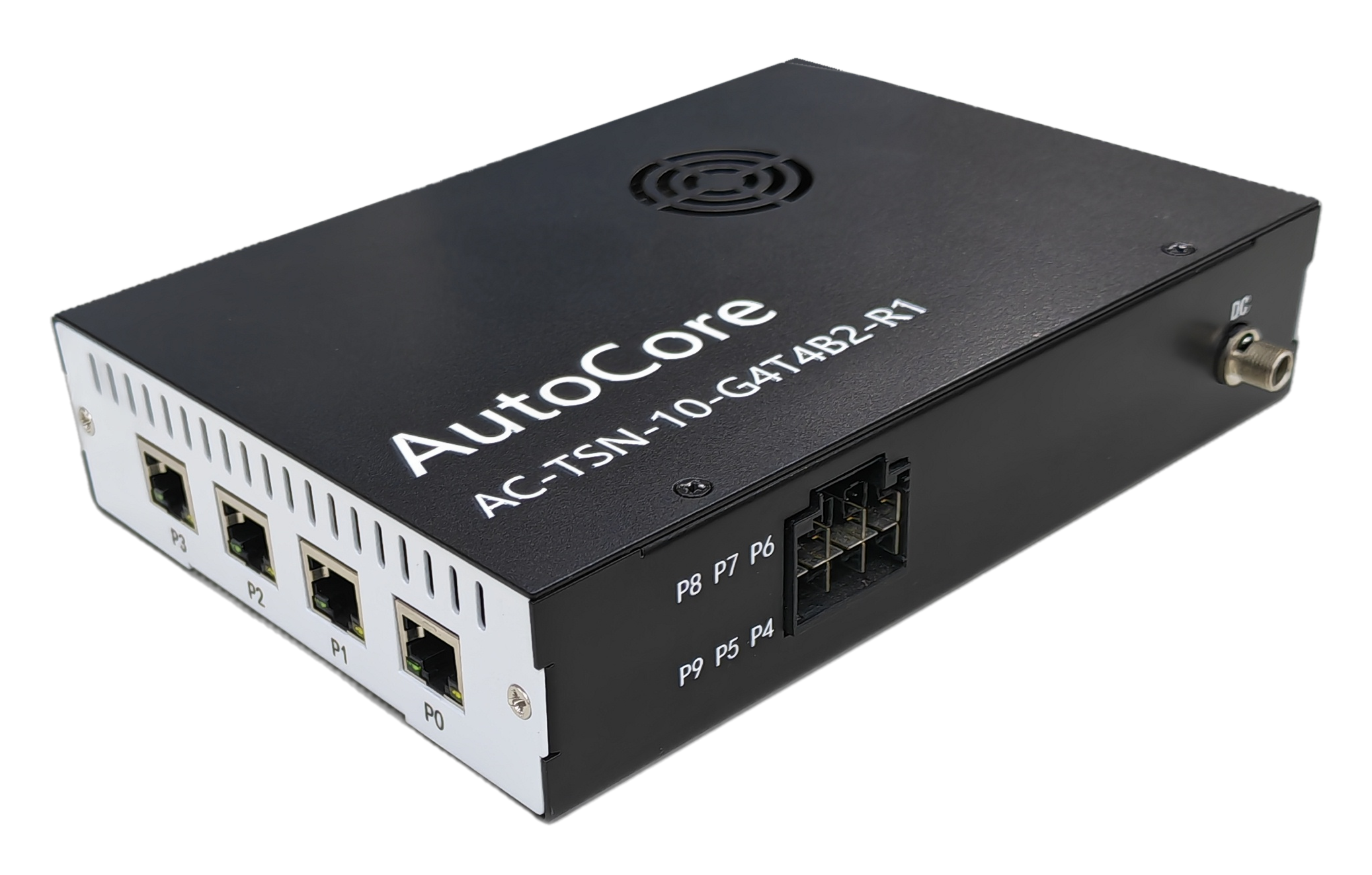
TSN Fusion hardware in a three-quarter view

Hardware in a three-quarter view: P0–P3 RJ45 service ports · P4–P9 automotive connector block · DC input. All four forms share one hardware platform; switching firmware images switches the role.

Standard Ethernet
P0–P3 · 4×10/100/1000M Base-TX (RJ45)
Automotive Ethernet
P4–P9 · 4×100M + 2×1000M Base-T1 (automotive connectors)
Management Port
1×1000M Base-TX · Web configuration / diagnostics
Serial Port
1×Mini USB console
Reserved
CAN · IO (reserved internally, exposed as required)
Dimensions / Mounting
188 × 140 × 40 mm · Desktop / wall / DIN rail
Environment / Power
-40–70°C / IP20 · DC 12V

Key Performance · Fully Hardware-Based Determinism

Six core TSN protocols implemented entirely in FPGA hardware, independently enabled or disabled

PERFORMANCE 01

~5us

Gigabit forwarding latency · Fully hardware-based forwarding, unaffected by software load or traffic bursts.

PERFORMANCE 02

<100ns

Hardware time-sync accuracy · 802.1AS / gPTP with 8 synchronization domains and PPS verification.

PERFORMANCE 03

0ms

802.1CB redundant failover · Frame replication and elimination provide seamless recovery over dual paths.

PERFORMANCE 04

<1us

Qbv gate scheduling precision · Deterministic forwarding within scheduled time slots.

PERFORMANCE 05

bit-level

Fault-injection granularity · Inline Tap, lossless pass-through and zero packet loss to actively validate redundancy protection.

PERFORMANCE 06

AS · Qbv · Qbu · Qav · Qci · CB

Six TSN protocols in hardware · Hard isolation for mixed traffic and clear boundaries between safety and non-safety services.

Web Management & Operations

What you see is what you configure · setup, apply and real-time diagnostics

STEP 1

Log In via Browser

Connect through the management port and open the Web configuration center without installing a client.

STEP 2

Configure in the Browser

Edit Qbv gate lists on a Gantt chart; configure gPTP / CB flow tables visually.

STEP 3

Apply & Persist

Apply with one click and retain configuration across power cycles.

STEP 4

Real-Time Diagnostics

Live front-panel view, port link status and traffic statistics.
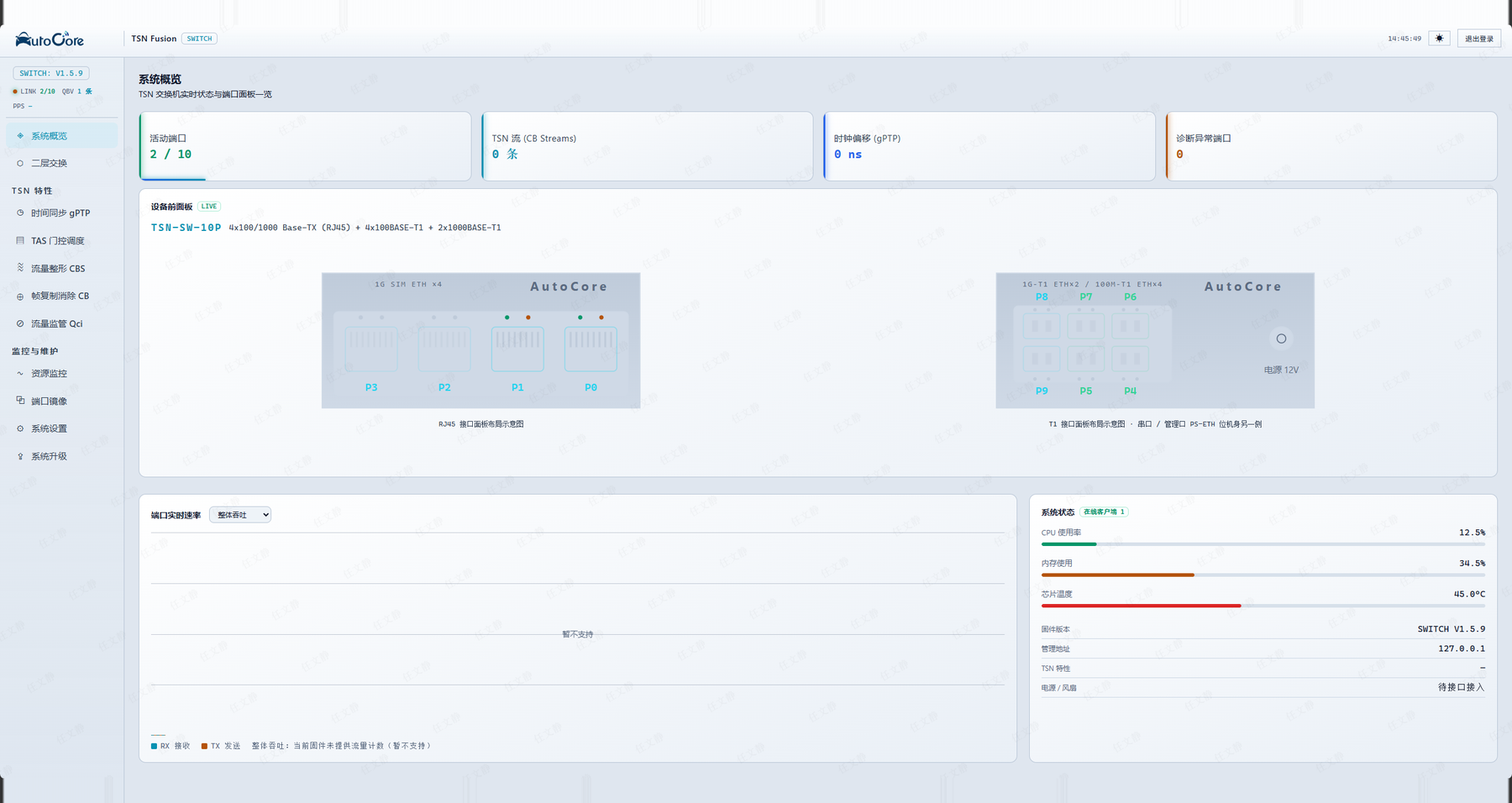
TSN Fusion system overview page

System Overview

Live front-panel view / port status / system cards—the full appliance state on one screen.
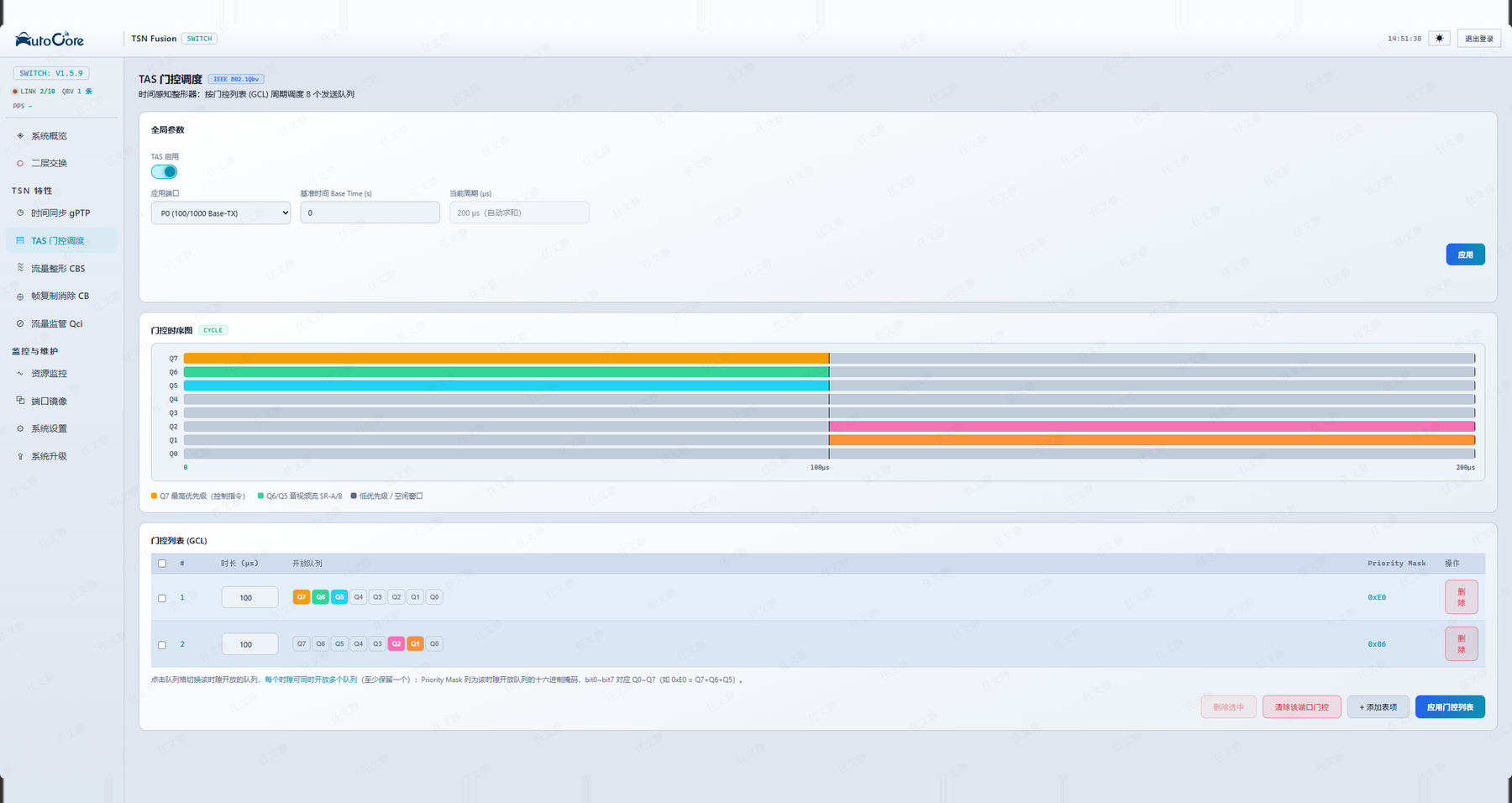
TSN Fusion Qbv gate Gantt chart

Qbv Gates

Edit the gate control list (GCL) on a Gantt chart and apply it with one click.
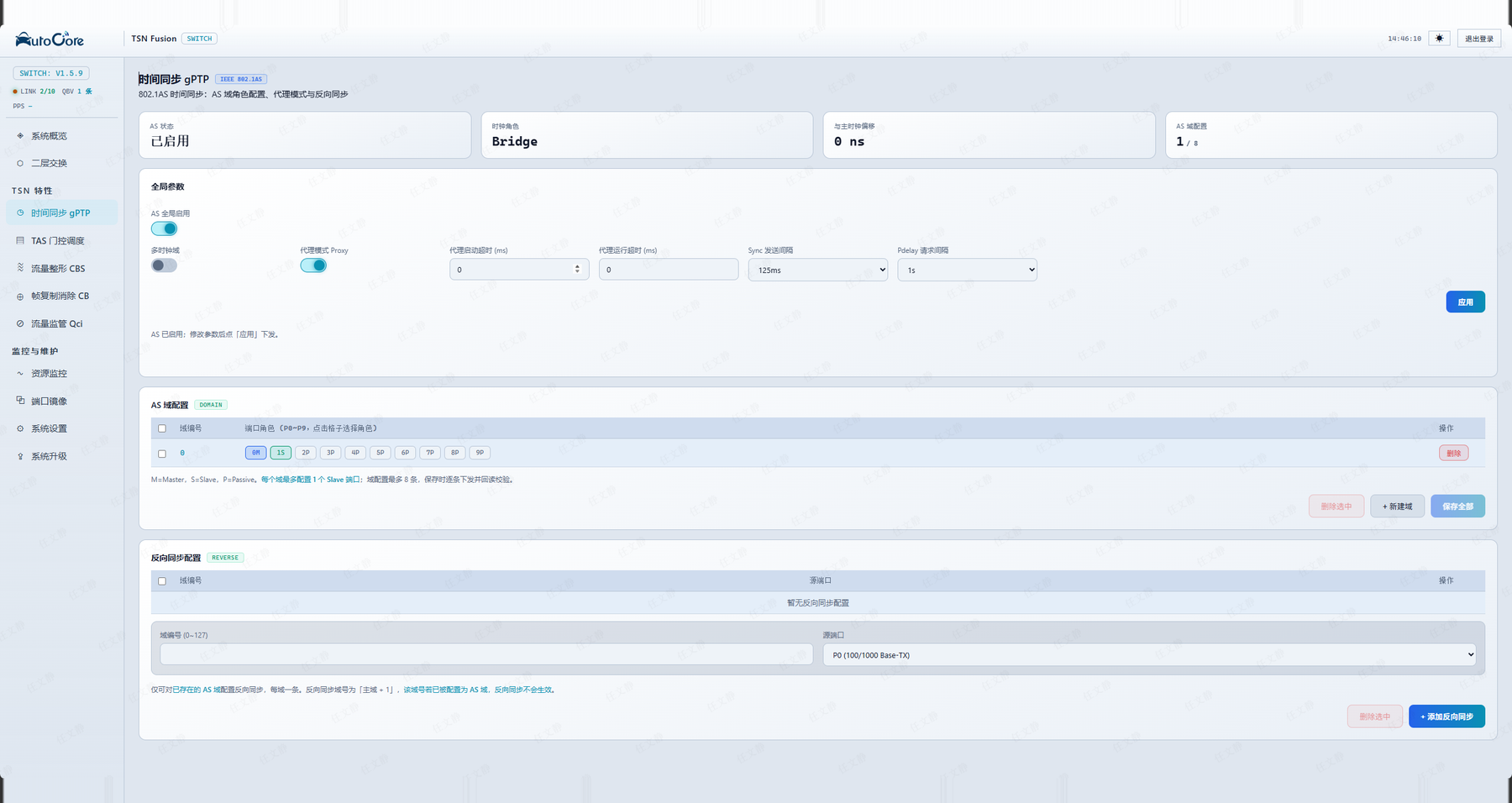
TSN Fusion gPTP configuration page

gPTP Synchronization

Configure domains / port roles / reverse synchronization, with PPS verification.
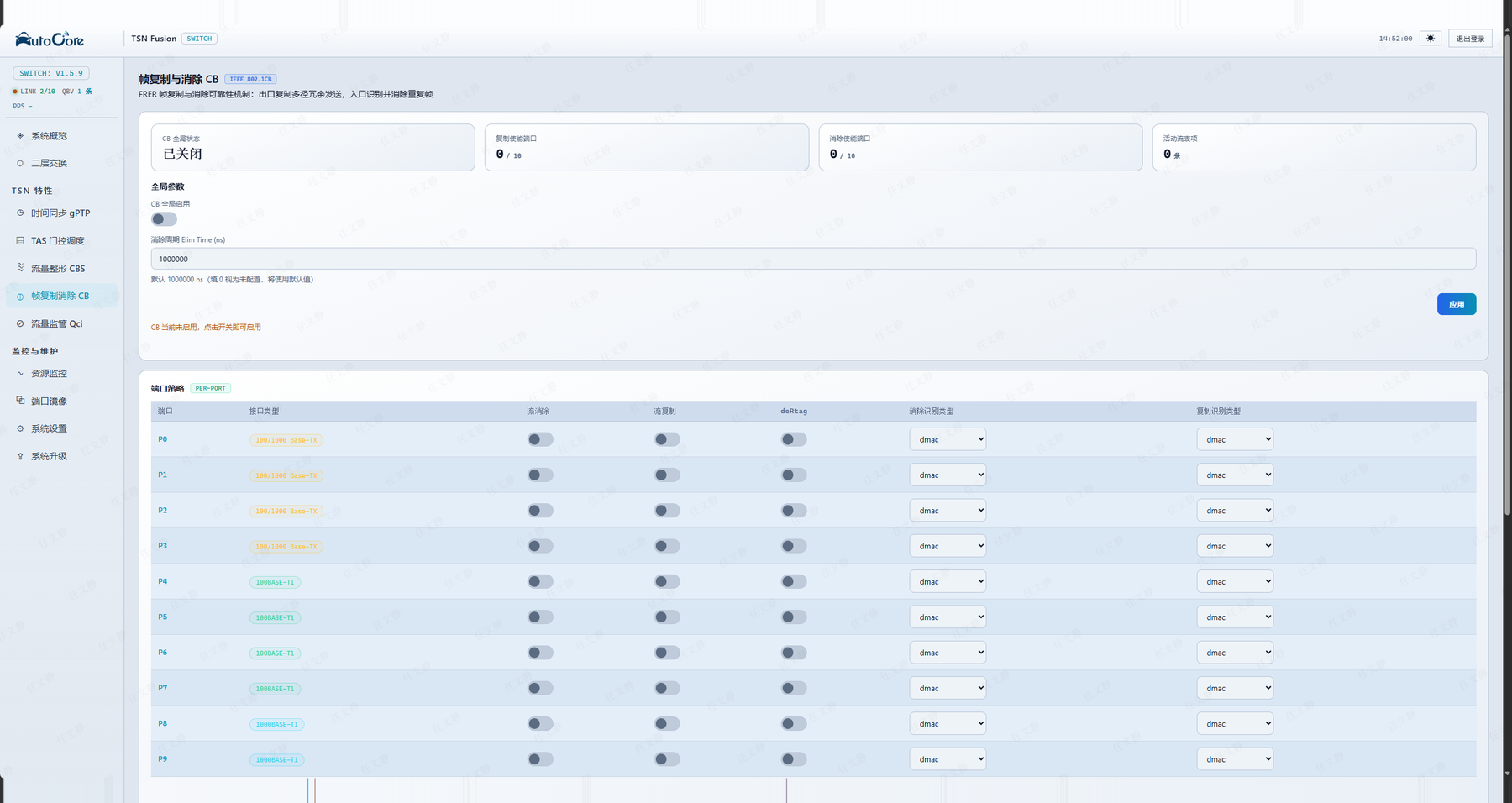
TSN Fusion CB redundancy configuration page

CB Redundancy

Configure replication and elimination flow tables by use case, with visual dual-path redundancy management.

Switching & Networking

  • VLAN membership and inter-VLAN connectivity
  • Port mirroring (source / destination / filter type)
  • Static + dynamic forwarding entries
  • Port rates and traffic statistics

Determinism & Redundancy

  • Qbv gate Gantt charts and GCL entries
  • Qav shaper idleSlope / sendSlope
  • Qci filtering / gating / metering entries
  • CB replication and elimination flow tables

Synchronization & Operations

  • gPTP domains and Master / Slave / Passive roles
  • Reverse synchronization / PPS verification
  • Web configuration center + host software for coordinated operations
  • Firmware upgrade / restart / factory reset

Industry Solution Scenarios

Automotive electronics · Industrial automation · Rail transit · Aerospace

Automotive Electronics · Development Bench

Connect cameras, LiDAR and other sensors with domain controllers over TSN; monitor and inject faults inline without affecting the link. Switch interconnect + Tap monitoring closes the test-bench loop.

  • Inline monitoring with zero impact and no link interruption
  • Mirror gPTP / Qbv behavior to an analysis PC for full traceability
  • Bit-level fault injection validates 802.1CB 0ms redundant failover

Industrial Automation · Shop-Floor Lines

Control and vision traffic share one network; existing PROFINET / EtherCAT / EtherNet-IP islands join the TSN backbone, carrying control, vision and legacy traffic together.

  • Qbv time slots lock the control cycle, with sub-microsecond inter-axis jitter
  • Qav reserves vision bandwidth; Qci isolates IT / OT
  • Gateway bridges legacy fieldbuses and protects existing investments

Rail Transit · Depots & Stations

ETB / ECN dual-ring test platforms with redundant fault injection; station CCTV / PIS video and control traffic share the network with hard isolation for certification boundaries.

  • CB dual-ring fault injection with zero packet loss and 0ms failover
  • Qbv time slots + Qci whitelists; Qav reservation for video
  • 802.1AS provides a network-wide time base for aligned event traceability

Aerospace · Launch Vehicle & Test Launch

A TSN backbone for every stage and A/B dual-plane redundancy; 1553B IMU bridging; ground test-launch umbilical access, disconnected before launch.

  • A/B planes + CB frame replication and elimination deliver zero loss on single-link failure
  • Qbv time slots + Qbu preemption deliver control commands with low latency
  • gPTP provides one time base across the vehicle for timestamp alignment

Related Products & Solutions